Provenance
Joint Publications Research Service report JPRS-UMA-91-012 (3 May 1991), translating an article from Kommunist Vooruzhennykh Sil No. 3, February 1991. Obtained from the Defense Technical Information Center (accession ADA333791). A work of the US government - public domain.
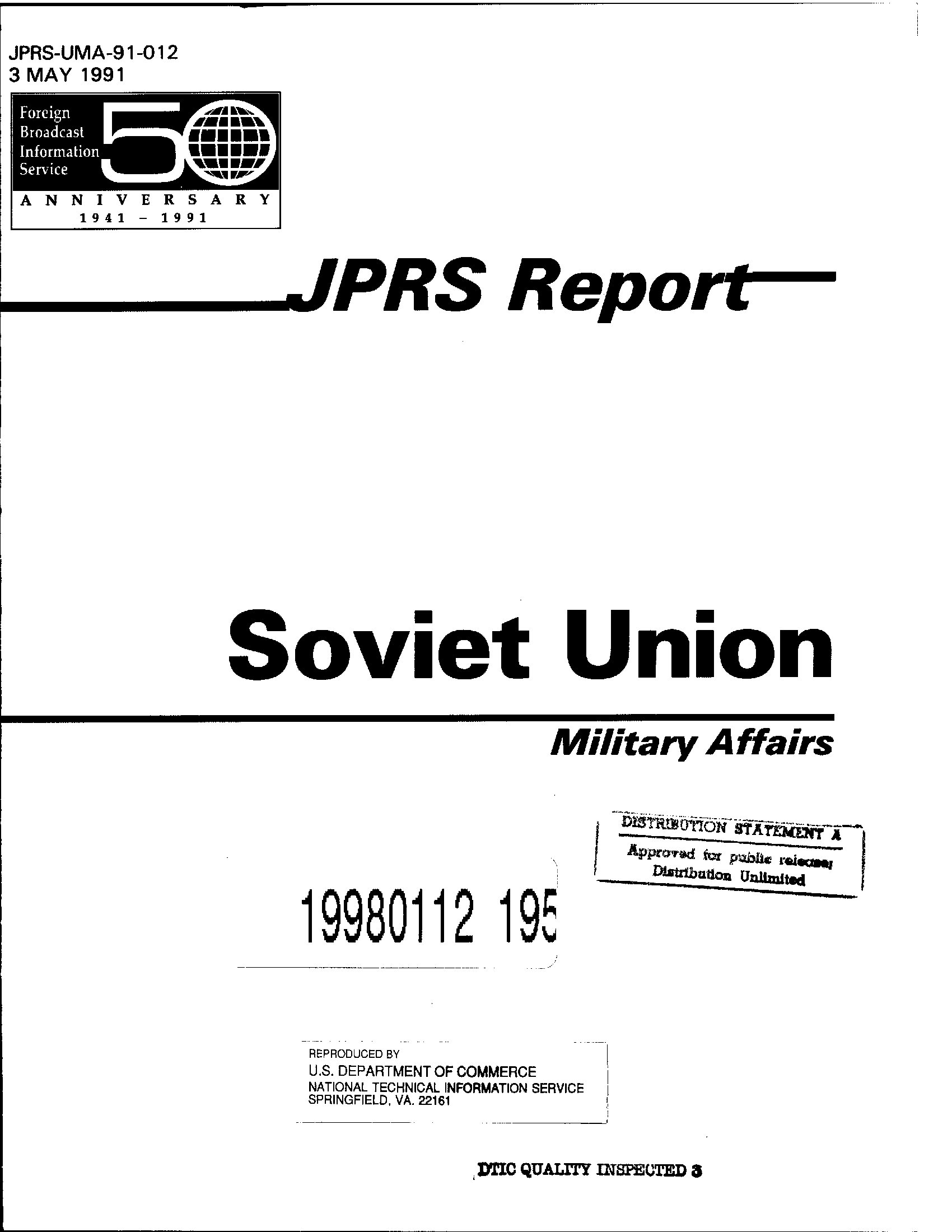
First page - click to open full document
In February 1991, the Soviet military-political journal Коммунист Вооруженных Сил printed an article by its special correspondent, Major Aleksandr Babakin: “Fortresses Alone Are Ineffective, or Why the Over-the-Horizon Radar System Was Shut Down.” It was the first serious public defence of the Duga radars and their chief designer, Franz Kuzminsky, published while Kuzminsky was still alive. Within weeks, the US government’s Joint Publications Research Service had translated it into English for the intelligence community. This is that translation: JPRS-UMA-91-012, dated 3 May 1991, with the article at pages 45–48.
JPRS translations are US government works (public domain) which makes this the only freely quotable English text of the article that started the rehabilitation fight. It preserves details the later retellings smooth over: the military lawyers finding a combat radar hall wrecked and cannibalized; Kuzminsky arguing before the joint State Commissions that the system “could quite effectively detect a massive missile launch” even if single launches escaped it; Colonel General Votintsev’s side of that argument; deputy minister Markov leaving his ministry post to take Kuzminsky’s director’s chair; and the institute party committee’s reprimand of the chief designer “for lack of personal discipline which was expressed in systematically failing to carry out the director’s orders.” Babakin spent the next seventeen years expanding this article into Battle in the Ionosphere, which this site hosts in translation, but the 1991 original is the period document, written and translated while the argument could still have been won.
The rest of the 88-page digest is its own time capsule of a collapsing military: forced retirements, referendum commissions, draft resistance in the Baltics, and the Krasnoyarsk radar treaty scandal, the same ministry culture that ate the ZGRLS, documented across every other page.
Source: Defense Technical Information Center, accession ADA333791 (citation page). Public domain as a US government work.