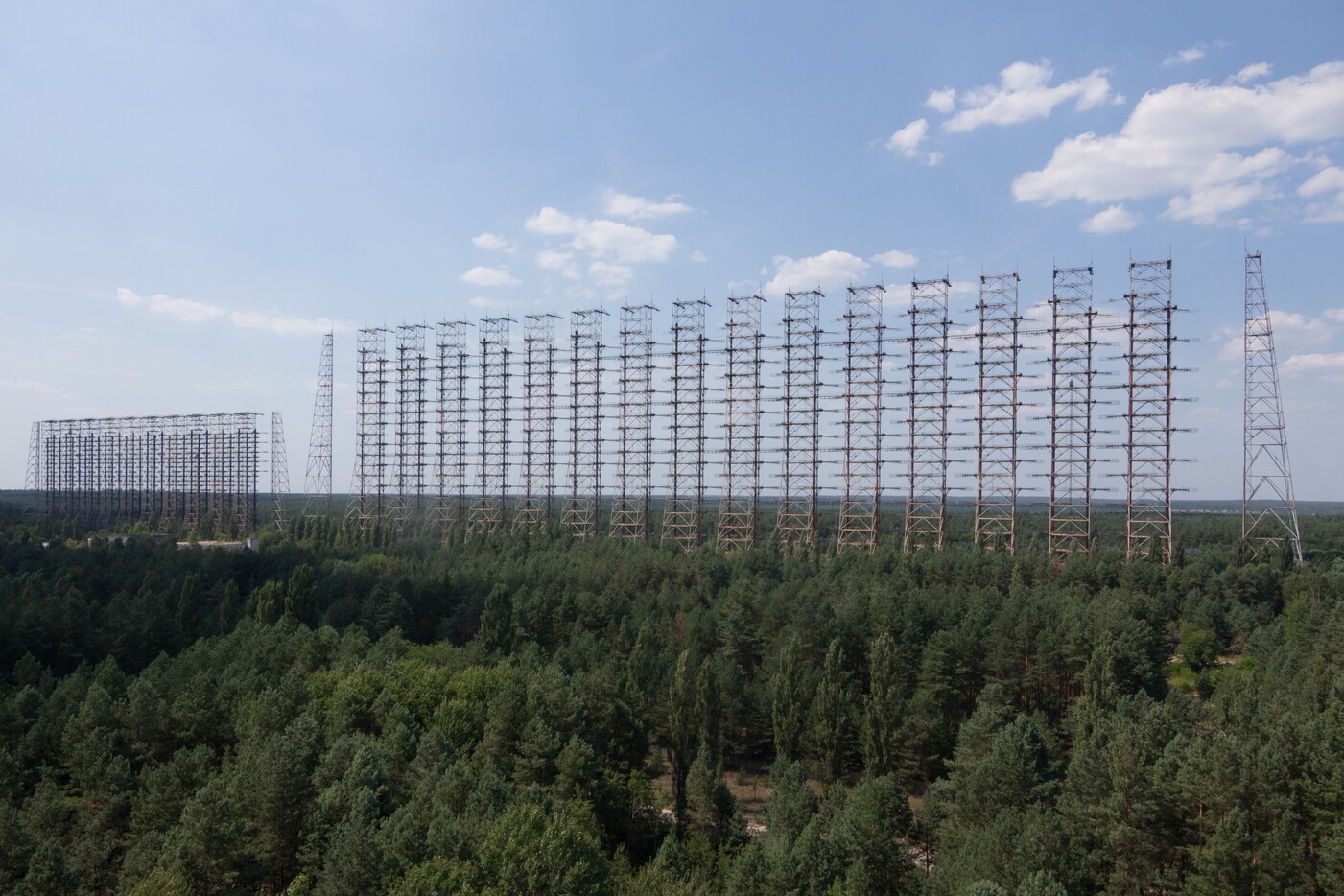
The Duga (Russian: Дуга; Soviet designation 5N32) over-the-horizon (OTH) radar holds a prominent place in my mind as one clear image I see when I think of Cold War era radar technology. Where the United States and NATO countries worked together to build radar lines, the Soviet Union took a massive, singular approach to watching the horizon. Although well known, largely because of the scale of the installation near Chernobyl and the abundance of photos of the antenna arrays, little documentation exists online on how the technology actually worked and how it came to be. In this article, I'll attempt to do both.
I'm calling the installation that's commonly known as the "Russian Woodpecker" by the NATO reporting name STEEL WORK (or STEEL WORKS) and not the oft-cited, but I believe incorrect based on my research, STEEL YARD. Declassified military theses from the Defense Technical Information Center of the US Military use the STEEL WORK designation1 , as does The International Countermeasures Handbook, 14th ed. (1989), published while the system was still on the air; Jane's Radar and Electronic Warfare Systems 1993–94 (p. 44), 1994–95 (p. 50), and 1995–96 (p. 54) use “Steel Works” as the plural form as well (fitting, as there were multiple installations). STEEL YARD only showed up online in the 2000s, likely from a mistranslation or etymological drift.
In order to get more closely sourced material, I've sourced and cited Russian-language resources (including side-by-side Russian and English text from sources that hadn't been available in English before) to fill in gaps in this article. I performed some translations with AI-based systems and flagged the AI translations where they appear. If a better translation is available, please reach out.
Early origins
In the late 1950s, Efim Semyonovich Shtyren (a chief designer of radio relay lines and USSR State Prize winner2 ) proposed the detection of aircraft at ranges of 1,000–3,000 km using shortwave radio refracted off the ionosphere. Together with his close associate Vasily Alexandrovich Shamshin3 and young scientists Efir Ivanovich Shustov4 and Boris Samoylovich Kukis, Shtyren theoretically substantiated the possibility and produced the foundational scientific report, which they named “Дуга” (Arc), because detection would occur over the curved surface of the Earth.
In 1969, a resolution of the Central Committee and Council of Ministers authorized an over-the-horizon ballistic missile detection system; secondary Russian sources give the date as September 29th.5 Development was carried out by NIIDAR6 (Научно-исследовательский институт дальней радиосвязи / Scientific Research Institute of Long-Range Radio Communication). By 1971, NIIDAR had developed the outline design of the OTH (Over The Horizon) 5N32 under chief designer Franz Alexandrovich Kuzminsky7 .
The concept received formal approval on January 18th, 1972. Construction began near Chernobyl for the first operational system (Radar Node No. 1) later that year (in March according to writings by Babakin8 ).
The Mykolaiv prototype
Even though the installation near Chernobyl is the most well-known, the project didn't begin (or end) there. From 1966, NIIDAR built an experimental, reduced-scale OTH rader near Mykolaiv on the Black Sea (with a receiver near Kalynivka and transmitter near the village of Luch) under the designation 5N77.9 On November 7th, 1971, the prototype detected its first missile launches, and that success carried the program into full-scale development under the combat designation 5N32.10 11
Meanwhile, back in the US, intelligence agencies were not ignorant of the USSR's progress. A 1968 CIA scientific-intelligence report tracked Soviet ionospheric research “related to the development of an over-the-horizon detection system” years before the big arrays went up.12 By April 1973, the construction near Kiev was appearing in the President's Daily Brief, transmitter-and-receiver geometry and all. Imagery analysts had already mapped the Mykolaiv site.13
The Chernobyl node
Radar Node No. 1 was a bi-static pair: the receiving station and its giant arrays at Chernobyl-2, and the transmitter 50–60 km away near Liubech in Chernihiv Oblast.14 Around the receiver grew a closed military town (officially a “Separate Radio-technical Node,” unofficially Chernobyl-2) complete with its own school, shops, and garrison housing. Public maps notable didn't list the village.15
The station was an enormous consumer of everything. Its former commander, Volodymyr Musiyets, said the radar and its computing drew the output of nearly an entire power unit of the neighboring Chernobyl nuclear plant; which meant the siting next to the USSR's newest nuclear station was no accident.16 This would suggest a 725-925 MWe net power draw, if true; it's possible this figure was exaggerated as that sounds like an extremely high draw to me. The signal processing ran on the K340A, the residue-number-system computer I've written about separately. However, even after initial completion, its operators judged it to be significantly underpowered. 17
The eastern twin reached combat duty first with the Komsomolsk-on-Amur node accepted on June 30th, 1982. The Chernobyl node followed in 1985, on experimental combat duty, with state trials of its modernization running into 1986.18 Crews drilled against actual events; Musiyets describes tracking American Space Shuttle launches as practice targets.19
How it worked
Ordinary radar is line-of-sight; the Earth curves away beneath the beam a few hundred kilometers out. Over-the-horizon radar takes a different approach by bouncing HF energy off the ionosphere. You aim a powerful shortwave signal upward at a shallow angle, let the ionosphere refract it back down thousands of kilometers away, and listen for the faint backscatter that returns by the same path. Do the signal processing right, and a missile plume punching through the ionosphere shows up against the clutter.20
Duga was bi-static with the transmitter and receiver separated by tens of kilometers, so its own transmitter did not deafen the receiver. The receiving site fielded two arrays of cage dipoles hung on steel lattice masts in front of a wire reflector screen, dividing a design band of roughly 5–28 MHz between them. The larger, low-band array at Chernobyl-2 stands about 135–150 m tall and 460–500 m long; the high-band array about 100 m tall and 230–250 m long.21
Each transmitted pulse carried BPSK phase modulation using a 31-bit pseudo-random sequence, 100 µs per bit, giving a 3.1 ms pulse the receiver could correlate against to dig echoes out of noise and clutter.22 The pulses repeated at about 10 per second, each transmission typically around 40 kHz wide (though a 1988 FCC study logged bandwidths from 20 to 800 kHz), landing anywhere in roughly the 7–19 MHz range as ionospheric conditions dictated.23
Western observers estimated the effective radiated power at up to 10 MW EIRP, a figure that includes the enormous antenna gain; the transmitter's actual output was far lower.24
The Woodpecker
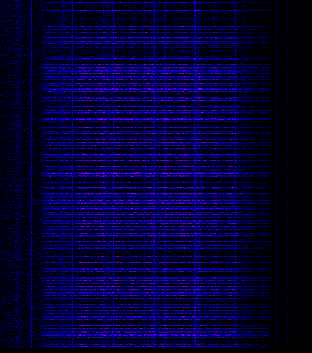
In July 1976, shortwave listeners around the world started hearing a sharp, repetitive tapping, ten times a second, stomping across broadcasts, amateur bands, and aviation channels without warning. Somebody called it a woodpecker, and the name stuck.25
Quickly, the noise had reached the top levels of US leadership. The President's Daily Brief for November 29th, 1976 told Gerald Ford that “signals from a Soviet over-the-horizon radar near Kiev are disrupting radio communications in a large part of the Northern Hemisphere,” with Scandinavia hit worst and a second radar near Komsomolsk expected “about 1978.” Notably, the CIA judged the radar “best suited to detect aircraft”. 26
The radio world fought back. Manufacturers sold purpose-built “woodpecker blankers” (the Datong SRB2, the AEA “Moscow Muffler”) and the technical press published serious engineering treatments of how to gate out a 10 Hz pulse train.27 The Association of North American Radio Clubs organized a coordinated logging campaign to put data in front of regulators, and some amateurs simply keyed synchronized CW back at it; listeners noticed that playing recordings of the Woodpecker at it seemed to make it hop frequency.28 At the fringes, the pulses fed a cottage industry of mind-control panic.29
You can hear it yourself:
A period recording of the Woodpecker signal, via archive.org. More recordings and spectrograms at the Signal Identification Wiki.
To my ear, it sounds a lot more like helicopter rotor blades than the sharper sounds of a woodpecker; but I can see the analogy. Regardless, having this sound suddenly appear, cutting into radio transmissions, would have been unnerving. Even today, listening to it gives a sense of foreboding, an audio signature of the nuclear fears surrounding the Cold War.
The fight inside
The Duga's hardest battles were internal. The Mykolaiv trials had promised easier detection of launches through the disturbed polar ionosphere (the path to the American missile fields), but detecting them proved far harder, and the military-industrial establishment contested the system's value from the start30 .
Babakin's book documents the internal fighting: a secret letter to the General Staff urging the system's closure, a New Year's newspaper attack on the program, and the removal of chief designer Kuzminsky in August 1981, followed by his quiet rehabilitation.31 The computing shortfall was part of the indictment, with the K340A-based processing judged insufficient for the ionospheric modeling and clutter rejection the mission demanded. Even today, modern radar systems take extensive processing power to sort through noise and produce clean results. Doing it with 80s-level hardware in the Soviet Union was nearly impossible.
The accident and the end
At 01:23 on April 26th, 1986, reactor No. 4 exploded nine kilometers away from Radar Node No. 1 (Chernobyl-2). Commander Musiyets ordered the radar shut down by late morning; with the node's servicemen pressed into disaster response. Evacuations of the town of Chernobyl-2 began on the evening of April 27th.32 The station never transmitted again. They mothballed the station in 1987, dismantled its main equipment and shipped it east to Komsomolsk-on-Amur, and disbanded the garrison in 1988. 33
The Far East node soldiered on alone until a fire ended its operation and removed it from combat duty on November 14th, 1989. Western listeners logged the last Woodpecker signals that December, and the shortwave bands went quiet.34
What's left
The receiving arrays at Chernobyl-2 still stand, and those spared only because they stood inside an exclusion zone nobody could redevelop. In the early 1990s, people stripped the site of valuable metals. The site then became one of the zone's iconic tour destinations. In 2021, Ukraine added the site to its State Register of Immovable Monuments.35
Everything else is gone. Sold for scrap in 1997, the Komsomolsk-on-Amur complex's new owner had dismantled it by 1998. The Mykolaiv prototype arrays came down in the early 2000s and the Liubech transmitter site was dismantled after the shutdown. 36
Russian forces occupied the exclusion zone (Chernobyl-2 included) from February 24th to March 31st, 2022. The arrays came through standing, but the Russian forces mined and looted the zone. For safety reasons, the Ukrainian government suspended all tourism ever since; for now, the best access is remote. 37 A community photogrammetry model on Sketchfab preserves the array in 3D. The documentary The Russian Woodpecker (2015) (a Sundance Grand Jury Prize winner) has some of the best footage ever shot of the structure, though its theory of an engineered Chernobyl disaster to bury the radar's failure is missing supporting evidence. 38
The idea of OTH radar didn't die with these arrays, if anything they opened the imagination of future designers. Russia's modern over-the-horizon radar, the 29B6 “Container” near Kovylkino in Mordovia, went on experimental duty in December 2013 and full combat duty on December 1st, 2019 and has Ukrainian drones have targeted it since 2024.39
Today, I'm still trying to gather and learn more about how the technology of these arrays operated and what life was like at the stations themselves. If you have more information, please reach out to me with details. My personal white whale is a copy of the software logic of the radar itself, although I fear it lost forever to time.
Resources
Everything I've found and used on the Duga; where a source backs a specific claim, it's footnoted in the text above. The foundation of this article is Babakin's Battle in the Ionosphere, which is translated into English in full.
Declassified and archival
- CIA OSI, Soviet Research Related to the Development of an Over-the-Horizon Detection System, OSI-STIR/68-18 (1968, declassified) (archive)
- President's Daily Brief, April 13th, 1973 (declassified 2016)
- President's Daily Brief, November 29th, 1976 (declassified 2016)
- CIA/NPIC Imagery Analysis Service Notes (declassified)
- Russian State Archives guide (archive): NIIDAR institutional records
Histories and technical literature
- Бабакин А.Н., Битва в ионосфере (2008): our English translation
- Дубровский & Костюченко, “История ЗГРЛС «Дуга»” (2012): CyberLeninka
- Цепелев, Военная мысль №12 (2018): CyberLeninka
- J.M. Headrick and M.I. Skolnik, “Over-the-Horizon Radar in the HF Band,” Proceedings of the IEEE 62, no. 6 (1974)
- J.M. Headrick, “HF Over-the-Horizon Radar,” ch. 24 in Skolnik (ed.), Radar Handbook, 2nd ed. (1990) (PDF)
- Development of Over-the-Horizon Radar in the United States (DTIC ADA445505): the American OTH programs for contrast
- GlobalSecurity, “5N32 Duga (Arc) Steel Yard”
Operator accounts
- interview with Volodymyr Musiyets, Holos Ukrayiny, April 26th, 2013 (archive): the Chernobyl-2 commander, 1984–88
- Ukraïner's oral history of the Duga (2024) (archive): long-form oral history with Musiyets
- Suspilne Chernihiv on Liubech-1 (2021, archived): the Liubech-1 transmitter garrison
- pripyat.com community history (archived): the zone community's reference article
Period Western coverage
- “Mystery Soviet Over-the-Horizon Tests,” Wireless World, Feb 1977, and J.P. Martinez's Apr 1982 signal analysis, scans at mysterysignals.signalshed.com
- Monitoring Times, August 1985, pp. 4–6 (PDF): the ANARC Woodpecker Project and signal measurements
- David Nicholls, “Blanking the Woodpecker,” Ham Radio, January 1982, pp. 20–24 (PDF)
- Dave Beauvais, “Russian Woodpecker: Hazardous to Your Mental Health?,” Popular Communications, April 1984, p. 28 (PDF)
- Stan Horzepa, “Surfin': Remembering the Woodpecker,” ARRL (2009)
The site today
- archive.org: period signal recording (embedded above)
- Signal Identification Wiki: signal parameters and spectrograms
- photogrammetry model on Sketchfab
- The Russian Woodpecker (2015): with The A.V. Club's review providing good corrections
- VICE (2021): heritage-monument listing
- Journal of Radiological Protection 43 (2023): the 2022 occupation, assessed
- Amur-Bereg local-history thread (archived) and Urban3p object record (archived): the dismantled Far East twin
Sources & Resources
Books
- Battle in the Ionosphere (English Translation) Primary source for early Duga history, key designers, and institutional politics
- The Lippold thesis published in March, 1989 does; as does the Liu thesis from September, 2007. ↩
- Biographical details from Бабакин А.Н. Битва в ионосфере. М.: Цейхгауз, 2008; see Chapter 1 in our English translation. Radio relay work independently confirmed via NIIR, Russian Wikipedia: “Р-600 «Весна» диапазона 3,4-3,9 ГГц. (1953—1958 годы, Е. С. Штырен, Н. Н. Каменский).” ↩
- Career confirmed by multiple independent sources including the CNews obituary (2009) (archive) and his biography on Russian Wikipedia. Minister of Communications 1980–1989. Lenin Prize laureate for the “Ekran” system per NIIR, Russian Wikipedia. Connection to Duga: see Babakin, Battle in the Ionosphere (our English translation). ↩
- Named as deputy chief designer in Дубровский И.Н., Костюченко В.И. “История загоризонтной радиолокационной системы «Дуга»” // Приволжский научный вестник, 2012, №7(11), с. 17–22 (CyberLeninka). Biography from Babakin Ch. 8; see Chapter 8: Efir Shustov and Valentin Strelkin in our English translation. ↩
- The 1969 resolution: Ходаренок М. “Кривое ружье радиолокации” // VKO journal (archive). The specific September 29th date circulates in secondary Russian sources (e.g., Дуга, Russian Wikipedia) without archival confirmation. Designer personnel independently confirmed in Цепелев А.А. // Военная мысль, 2018, №12, с. 53–58 (CyberLeninka). ↩
- Institutional lineage documented in the Russian State Archives guide (archive); the institute adopted the NIIDAR name in 1972. ↩
- NIIDAR official “Our Pride” page: niidar.ru (dead link; Wayback Machine archive, Dec 2021; contains Kuzminsky’s April 1982 autobiography: born February 2nd, 1922, Pokatilov village; MAI student 1939; Red Army volunteer July 1941 (PVO); demobilized Oct 1945; graduated MAI April 1949; NII-2 engineer from March 1948; KB-1 deputy chief designer from Dec 1951; NII-37/NIIDAR chief engineer from Dec 1963; chief designer topic 5N77 from Aug 1968; NIIDAR director from Feb 1975; removed August 24th, 1981 by Minister Pleshakov; retired June 1983). Also: rti-stories.ru biography (dead link; Wayback Machine archive, Feb 2021); famhist.ru entry (Wayback archive; independently states: born 1922, KB-1 deputy lab head from 1951, NIIDAR chief engineer 1964, OTH chief designer from 1968, NIIDAR director 1975–1981, died 1991). Confirmed in Dubrovskiy & Kostuchenko (2012) and Tsepelev (2018). Babakin, Battle in the Ionosphere (our English translation) devotes Chapters 1–2 and 11–13 to Kuzminsky’s career and removal from his position. ↩
- “March 1972” appears in Babakin’s Battle in the Ionosphere and derivative sources. I could find independant confirmation of 1972 as the year, but the specific month is single-source in Babakin’s book. ↩
- GlobalSecurity, “5N32 Duga (Arc) Steel Yard”, drawing on Babakin and NIIDAR institutional histories. Kuzminsky’s own autobiography lists him as chief designer of “topic 5N77” from August 1968. ↩
- Дубровский & Костюченко (2012), CyberLeninka; GlobalSecurity, “5N32 Duga (Arc) Steel Yard”. The date, the anniversary of the October Revolution, is suspiciously patriotic, though it appears consistently across the NIIDAR-lineage sources. ↩
- A note on names, because the literature is a mess: the Mykolaiv prototype is usually just “Duga,” the Chernobyl-2/Liubech pair is Duga-1, and the Far East pair is Duga-2, though some Russian sources in the Babakin lineage call the Mykolaiv system itself “Duga-2.” The “Duga-3” label often attached to the Chernobyl array in Western sources is a misnomer. See Duga radar, Wikipedia and GlobalSecurity, “5N32 Duga (Arc) Steel Yard”. ↩
- CIA OSI, Soviet Research Related to the Development of an Over-the-Horizon Detection System, OSI-STIR/68-18 (1968, declassified) (archive). ↩
- President’s Daily Brief, April 13th, 1973 (declassified 2016); CIA/NPIC Imagery Analysis Service Notes (declassified) (comparing a new Soviet-built HF antenna in Cuba to “the Soviet OTH radar under construction at Nikolayev”). ↩
- Duga radar, Wikipedia gives ~50 km; Дубровский & Костюченко give 60 km. On the Liubech-1 garrison itself, see Suspilne Chernihiv on Liubech-1 (2021, archived). ↩
- pripyat.com community history (archived); interview with Volodymyr Musiyets, Holos Ukrayiny, April 26th, 2013 (archive). ↩
- interview with Volodymyr Musiyets, Holos Ukrayiny, April 26th, 2013 (archive); Ukraïner’s oral history of the Duga (2024) (archive). ↩
- See our K340A article and Babakin, Battle in the Ionosphere (our English translation). ↩
- Дуга, Russian Wikipedia; Дубровский & Костюченко (2012), CyberLeninka. ↩
- Ukraïner’s oral history of the Duga (2024) (archive). ↩
- This is described in J.M. Headrick and M.I. Skolnik, “Over-the-Horizon Radar in the HF Band,” Proceedings of the IEEE 62, no. 6 (1974), and J.M. Headrick, “HF Over-the-Horizon Radar,” ch. 24 in Skolnik (ed.), Radar Handbook, 2nd ed. (1990) (PDF). For the ionosphere itself, the NOAA Space Weather Prediction Center ionosphere primer is a good initial read. ↩
- Дуга, Russian Wikipedia; Duga radar, Wikipedia gives the combined structure as roughly 700 m long and 150 m high. Western imagery analysts described “large, stacked, horizontal dipole arrays… electrically steered” (CIA/NPIC Imagery Analysis Service Notes (declassified)). ↩
- First worked out publicly by radio amateurs: J.P. Martinez, letter, Wireless World, April 1982, p. 89, scans at mysterysignals.signalshed.com. This reminds me of the concept of a nonce used in authentication protocols as well. ↩
- Pulse-timing and bandwidth measurements in David L. Wilson’s analysis, Monitoring Times, August 1985, pp. 4–6 (PDF); FCC study figures per Duga radar, Wikipedia. ↩
- “Mystery Soviet Over-the-Horizon Tests,” Wireless World, February 1977, p. 53: scans at mysterysignals.signalshed.com. ↩
- Duga radar, Wikipedia, citing contemporary press. The suspiciously poetic “July 4, 1976” start date (lining up with US independance day) appears only in pop retellings. ↩
- President’s Daily Brief, November 29th, 1976 (declassified 2016). The brief includes a map of the Kiev and Nikolayev sites. ↩
- David Nicholls, “Blanking the Woodpecker,” Ham Radio, January 1982, pp. 20–24 (PDF); Hackaday’s Woodpecker retrospective (2021). ↩
- Monitoring Times, August 1985, pp. 4–6 (PDF) (the ANARC “Woodpecker Project”); Stan Horzepa, “Surfin’: Remembering the Woodpecker,” ARRL (2009). ↩
- Dave Beauvais, “Russian Woodpecker: Hazardous to Your Mental Health?,” Popular Communications, April 1984, p. 28 (PDF): “Some experts say the Soviets are sending ‘mind control’ signals!” Period paranoia, not that we don’t have plenty of those today, too! ↩
- This is the central narrative of Babakin, Battle in the Ionosphere (our English translation); the performance controversy is corroborated in Дубровский & Костюченко (2012), CyberLeninka. ↩
- See Chapter 10 and Chapter 11 of our translation, along with Chapters 1–3. ↩
- interview with Volodymyr Musiyets, Holos Ukrayiny, April 26th, 2013 (archive) (Musiyets describes giving the shutdown order and his own radiation dose); Ukraïner’s oral history of the Duga (2024) (archive). ↩
- Дуга, Russian Wikipedia; interview with Volodymyr Musiyets, Holos Ukrayiny, April 26th, 2013 (archive). ↩
- Дуга, Russian Wikipedia; Duga radar, Wikipedia. ↩
- VICE (2021); Kyiv-region tourism record; pre-2022 visitor documentation: CNN Travel (2019) and chornobyl.in.ua site documentation. ↩
- Дуга, Russian Wikipedia; Far East site documentation: Amur-Bereg local-history thread (archived) and Urban3p object record (archived). ↩
- Peer-reviewed assessment of the occupation: Journal of Radiological Protection 43 (2023); New Eastern Europe (2024) estimates ~€100M in damage zone-wide. The structure had earlier survived the April 2020 forest fires. ↩
- The A.V. Club’s review lays out the evidentiary hole; AFI’s interview with director Chad Gracia shows the director himself hedging. ↩
- Container radar, Wikipedia; radartutorial.eu; Defense Express (2024). ↩