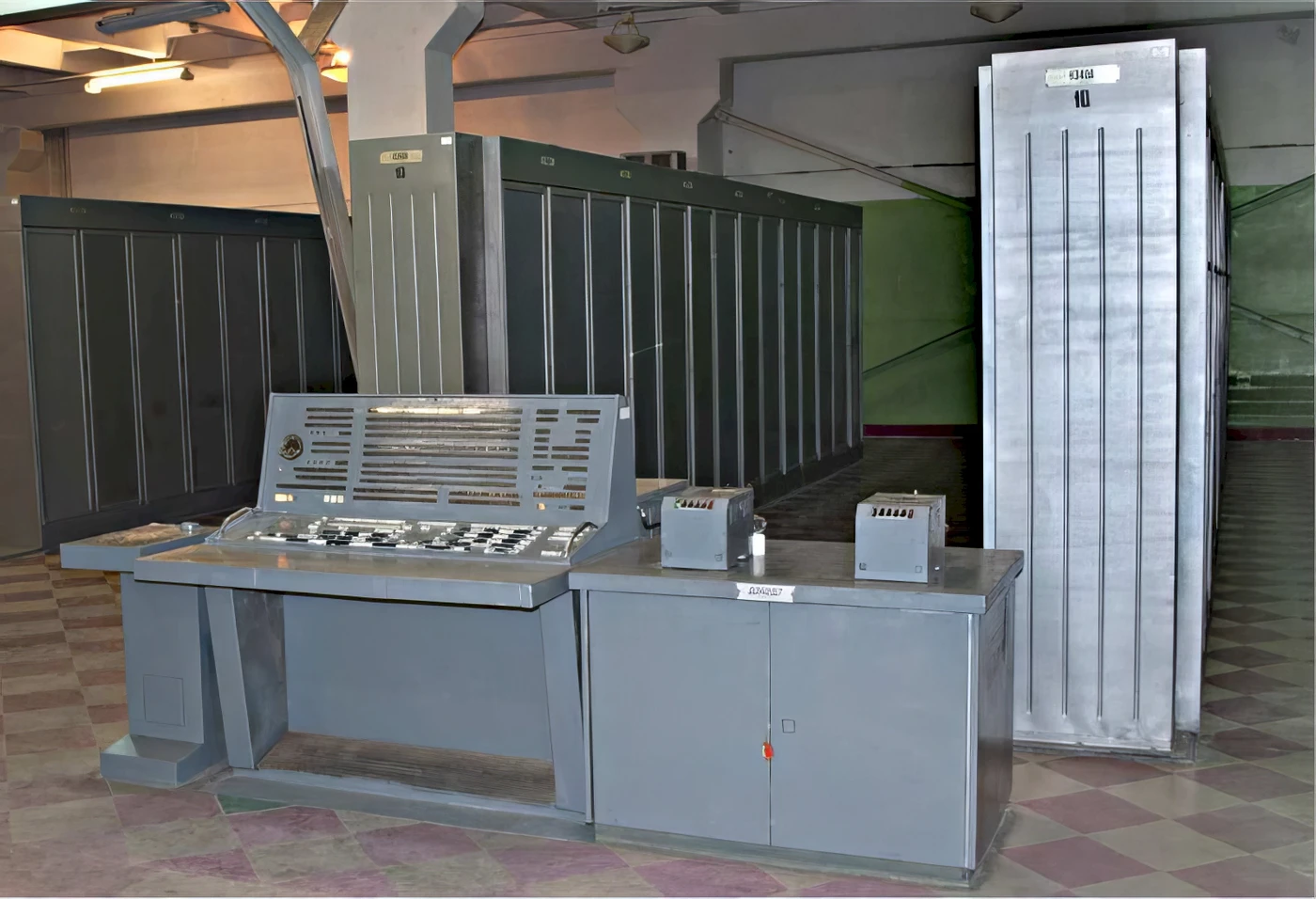
An extinct machine room with a K340A computer, 3 rows of cabinets and a remote control - this is the whole machine
Specifications
| Property | Value |
|---|---|
| Architecture | Transistor-based (1T308V), diodes, ferrite core memory |
| Components | 472,000 elements including 80,000 transistors |
| Performance | 1.25M double ops/s (2.5M simple ops/s) |
| Word Length | 45-bit (three-address, dual-operation instruction format) |
| Memory | 16K words data RAM, 16K words command storage, 4K-8K words constants (ROM) |
| Physical Size | 20 cabinets in 3 rows |
| Power | ~33 kW |
| Cost | 1.2M Soviet rubles (~2M USD) per machine |
| Units Produced | ~50 (1968-1976) |
The primary signal processor for the Soviet Duga over-the-horizon radar was the K340A, a purpose-built military computer that represents one of the most unusual computing architectures ever deployed operationally.
Designer and Origins
The K340A traces its intellectual roots to Czechoslovak professor Antonin Svoboda and his student Miro Valach, who in the 1950s developed the theory of using residue number systems for computation. A report on Svoboda's research reached Fedor Lukin, head engineer of Design Bureau 1 (KB-1, specialized in Soviet air defense systems), who forwarded it to Israel Yakovlevich Akushsky1 . Akushsky recognized that while RNS could not be universal, it would be excellent for specialized high-throughput machines.2
Akushsky shared his ideas with Davlet-Girey Islamovich Yuditsky3 , who had previously worked on the Strela and Ural computers.2 In 1960, Lukin became head of Institute-37 (later NIIDAR) and invited both scientists to join the institute where Duga was eventually designed.2 Yuditsky was the initial chief designer of the K340A; when he transferred to NIIFP in Zelenograd in January 1964, L. V. Vasiliev took over and saw the machine through to production.4 Yuditsky was described by colleagues as "an active, cheerful person with sharp wit" who assembled a team of talented young specialists from across the Soviet Union.5
Development lineage: The K340A was the third in a series of RNS computers:2
- A340A: experimental 20-bit machine, 5,000 operations per second
- T340A: second-generation machine built on ferrite-transistor logic (1960–1963)
- K340A: production version (1963–1966)
A 1972 report by Yuditsky and Akushsky revealed additional details: they had patented their innovations in several countries including the United States, France, and the United Kingdom.2
The critical advantage: addition and multiplication can be performed independently on each residue channel in parallel, with no carry propagation between channels. This eliminates the carry chain that limits speed in conventional binary arithmetic, allowing all digit positions to be computed simultaneously.
The trade-off: comparison operations (greater-than, less-than) and division are extremely expensive in RNS, requiring conversion back to a positional number system using the Chinese Remainder Theorem (CRT), described in Russian sources as causing "a monstrous drop in performance" ("чудовищное падение производительности").6
The Soviet Union was lagging behind the West in microelectronics. RNS offered a way to achieve high computational throughput using relatively primitive hardware; because each residue channel operates independently and uses small numbers (bounded by the modulus), the individual arithmetic units could be simpler and slower while the parallel architecture still achieved competitive aggregate throughput. The K340A's architecture was designed so that all radar signal processing (correlation, FIR filtering, and FFT computation) could remain entirely within the RNS domain, avoiding expensive CRT conversions during the computational hot path. Conversions were reserved for output and display operations.
Hardware Specifications
- Architecture: Transistor-based second-generation computer, using discrete transistors (type 1Т308В), diodes, and ferrite core memory7
- Components: 472,000 elements including 80,000 transistors (per the 1972 Yuditsky/Akushsky report)2
- Performance: Performance hit 1.25 million double operations per second (2.5 million simple ops/s)8
- Word length: 45-bit words (three-address instruction format, executing two operations per command)
- Memory: 16K words of 45-bit RAM for data; 16K words for commands; 4K–8K words of constants storage9
- Physical size: 20 cabinets arranged in 3 rows (some sources report 12 cabinets of 600×700×1800 mm; the discrepancy may reflect different configurations or counting of peripheral cabinets, or variations in manufacturing)10
- Power consumption: ~33 kW11
- Cost: 1.2 million Soviet rubles per machine (~2 million USD at the time)2
- Production: Approximately 50 units manufactured between 1968 and 1976, at the NIIDAR experimental factory and the Sverdlovsk Radio Equipment Plant. By 1972, 10 had been produced, 2 were in adjustment, and 15 more were planned.12 2
- First test: Successfully tested at the 5N11 site; the initial Duga installation near Mykolaiv, Ukraine2
- Deployment: Primarily in the Dunai-3U long-range detection radar (10 machines per installation), the A-35 Moscow ABM system, and the Duga over-the-horizon radar. The Dunai-3U was the only other installation where K340As were used, and the last where any were still operating until at least November of 2010.13 2
- Error detection: Unique built-in capability to detect single arithmetic errors using redundant RNS properties, an inherent advantage of modular arithmetic14
Detailed Rack Architecture
Physical examination of the Chernobyl-2 site by The Chernobyl Family (who provide significant updates, follow their Patreon if you're interested in more), combined with surviving documentation and testimony from a former engineer, has revealed the internal architecture of the K340A in considerable detail.2
A standalone K340A consisted of: 15–17 computer racks, 4 power supply racks (designated K254A), an operator's console, and a table-shaped rack with two connected printers. The racks used standard NIIDAR equipment housings containing small circuit cards ("cells"); approximately 50 variations of cells existed, occupying 1–3 slots with up to 50 slots per row. Each slot had a custom 35-contact connector made of epoxy resin, wired using wire-wrap. Inter-rack connections used coaxial cable; thin cables with small connectors were limited to 12 meters, while thicker cables could span up to 100 meters. Small auxiliary racks designated K341A contained passive resistor splitters for impedance matching between cable types.
The racks included data processing racks (A3–A6): Four racks forming the processor, containing ~600 cells across 12 rows.
- A3: system controller
- A4: high-speed processor buffer (16 × 45-bit words)
- A5 and A6: arithmetic-logical units for RCS calculations
One-side accumulator racks (including A7): Three to five racks for constants and program storage, each with a capacity of 4,096 × 45-bit words, loaded via ferrite-rod ROM cassettes (see below).
RAM racks (A8–A15): Eight racks called "accumulators of numbers." Each housed two independent accumulators with a capacity of 1,024 × 45-bit words each (with 27V power supplies). A key architectural feature: any accumulator could be deallocated from RAM and repurposed as an I/O buffer for data exchange with external devices; up to eight devices could connect directly to the processor controller, with additional devices served through deallocated RAM banks.
ROM Cassettes (НКС)
Visitors to the abandoned Chernobyl-2 site have observed and photographed unusual boards with pins, these are the ROM cassettes for the constants storage unit (НКС).15 Each accumulator rack contained four large crates, each holding 32 cassettes. Each cassette featured a two-way matrix with openings and coordinate rulers. In every opening sat two coils, into which tiny ferrite rods were inserted in one of two positions: fully inserted to inductively couple coils (logical "1"), or partially inserted (logical "0"). Reading was handled by 9 X-Y decoders per cassette, with data passing through amplifier cells to the processor buffer.2
Since programs and constants were rarely changed, there was no need for tape reels or punch cards. The ROM cassettes served as the primary program and constants loading mechanism.
Operator's Console and Output
The console was relatively small, used primarily for maintenance and overall control. It featured lightbulb-based indicators with masks bearing inscriptions, behind blue and orange filters.2 The central display had long rows of 45 light bulbs displayed processor registers grouped by the moduli of the RCS. Two ALU result registers showed final computation results before data was sent to the processor buffer. Two instruction register displays reflected the dual-instruction architecture: K1 (20-bit, for ALU operations) and K2 (25-bit, for data management: memory exchanges, jumps, external connections).
Status indicators were three rows that showed interrupt status (blocked, enabled, triggered). Indicators on the right displayed addresses and processor operation status. Two rows showed which RAM accumulators were allocated for RAM vs. deallocated for external data exchange. The machine had a time register and time counter, plus a real-time clock implemented as a standard aviation clock generating timing impulses.
As a "keyboard" there were buttons for entering K1 and K2 sub-instructions, value entry (the longest row), start/stop/step controls, data/address/instruction modification and override buttons, and a button to activate a built-in loudspeaker for announcements.
The output was a paper tape from MP16-2 numeric printers, capable of 25 rows per second with 20,000 rows per tape. Each row printed 16 symbols in decimal or octal format. Since the K340A used 45-bit words, a conversion control rack translated data into a printer-compatible format. Each machine had one active printer and one backup.2
Role in the Duga System
At Chernobyl-2, the K340A computing complex (designated 1С31Г) consisted of initially seven machine sets (MK/01 through MK/07), six in the main hall and one in an adjacent hall, with an eighth (MK/08) added in 1985 when designers concluded more complex algorithms were needed. Some MKs had extra racks doubling their storage capacity, and the power system supported centralized control with "hot reserve" machines for redundancy.2
A former engineer confirmed the machines served two primary tasks: processing trajectories and optimizing frequency-angular modes of operation. Multiple K340A machines ran algorithms that analyzed ionospheric conditions and suggested optimal operating frequencies, while others processed detected target data to determine trajectories and predict impact points.2
A small room adjacent to the main halls contained hard disk drives (same models used with ES mainframes) and a control rack, all K340A data was streamed to these disks, likely for transmission to NIIDAR Institute for research purposes. The engineer quoted in the Chernobyl family video noted that the Chernobyl Duga "never went on active duty" but was "somewhat operational," with significant ionospheric research conducted.2
The system was ultimately judged insufficient for the signal processing demands of the Duga radar, particularly the need for better ionospheric modeling and more sophisticated clutter rejection. A key factor was that civilian computers had a weakness in simultaneous processing of external connections, precisely the K340A's strength, making a simple replacement difficult.2 Plans were made in the mid-1980s to supplement or replace it with the ES-1060, with handmade S27 interface racks built to connect the two systems. But the Chernobyl disaster in April 1986 intervened before the upgrade could be completed.
Preservation
The Chernobyl Family began exploring the Duga site in August 2010 and undertook a research expedition in late 2016 to map remaining computer equipment and photograph surviving documentation (much of it severely degraded by 30 years of moisture exposure). They identified the K340A racks, decoded the console controls, recovered partial blueprints, and even located the same model of printer (MP16-2) and developed a USB controller for it.2
By 2021, an official work group had formed to create a Cold War museum in one of the buildings at Chernobyl-2, with a partially reconstructed K340A as the central exhibit, cleaned components assembled like a model, wired to a modern computer to recreate the lights and sound. This project was postponed indefinitely by the events of February 2022. The team continues to document Duga's history in digital form.2
- Израиль Яковлевич Акушский (Israel Yakovlevich Akushsky, 1911–1992). Specialist in computational mathematics who originated the idea of using the residue number system for high-speed computing in 1953–1956. He moved with Yuditsky from SKB-245 to NII-37 as laboratory chief. Source: Computer Museum, "Акушский Израиль Яковлевич." Also: Cyclowiki biography. ↩
- "Exploring K340A: The SECRET COMPUTER of CHERNOBYL DUGA RADAR | Russian Woodpecker": The Chernobyl Family (YouTube). Based on nearly ten years of research at the Duga site including physical examination of surviving hardware, recovery of deteriorating documentation, and interviews with a former engineer who worked with the ES-1033 at the site. The video documents: the A340A/T340A/K340A development lineage; the Svoboda → Lukin → Akushsky chain; 1972 report details (472K elements, 80K transistors, cost, patents); detailed rack architecture (A3–A15, K254A, K341A, S27); ROM cassette construction; 7+1 machine sets at Chernobyl-2; two primary tasks; hard disk data streaming; console layout and controls; MP16-2 printer system; and the postponed museum project. Boris Malashevich (referenced as having taken the only public photos of an intact K340A at Dunai-3U) is a key secondary source. ↩ ↩ ↩ ↩ ↩ ↩ ↩ ↩ ↩ ↩ ↩ ↩ ↩ ↩ ↩ ↩ ↩ ↩ ↩ ↩
- Full name: Давлет-Гирей Ислам-Гиреевич Юдицкий (Davlet-Girey Islam-Gireevich Yuditsky, 1929–1983). Born in Baku, died of a heart attack during a work assignment in Priozersk at age 53. He shortened his patronymic from the Turkic "Islam-Gireevich" to "Islamovich" in the 1950s. Source: Computer Museum biography, "Глава 2. Давлет Исламович Юдицкий. Биография." ↩
- Yuditsky was initial chief designer of the K340A. When F.V. Lukin invited him to head the new NIIFP institute in Zelenograd in January 1964, L.V. Vasiliev took over as chief designer and saw it through production. Source: Computer Museum, "Д.И. Юдицкий и модулярные суперсистемы." Also: Sorucom 2017 conference paper. ↩
- The Computer Museum biography quotes colleagues describing him as "активный, веселый человек с острым умом" (an active, cheerful person with sharp wit). He was known for refusing co-authorship on papers he didn't write. Source: Computer Museum biography (see akushsky note). ↩
- The phrase "monstrous drop in performance" appears in Russian-language discussions of the RNS trade-offs. Source: Topwar.ru, "The birth of the Soviet missile defense system. Greatest modular computer." ↩
- The K340A used discrete transistors (type 1Т308В), diodes, and ferrite cores. It was NOT a vacuum tube/transistor hybrid as sometimes stated in English-language sources. The Sorucom 2017 paper explicitly identifies the transistor type. Also: Computer Museum, "Неизвестные модулярные суперЭВМ" lists element base as "транзисторы, диоды, ферриты." ↩
- Multiple authoritative Russian sources report: 1.25 million double operations per second = 2.5 million simple operations per second. The K340A used a three-address instruction format where each command contained two operations. The cost per operation was reportedly 25 kopecks. Russian sources consistently claim this was "the first computer in the world with performance exceeding 1 million operations per second" ("первая в мире ЭВМ с быстродействием, превышающим миллион операций в секунду"), but this claim doesn't hold up. The CDC 6600 (operational 1964, Seymour Cray, Control Data Corporation) achieved ~3 MIPS (well over 1 million ops/sec) and the IBM 7030 Stretch hit 1.2 MIPS in 1961. Even the Soviet BESM-6 (1968) is generally cited at 1 MIPS. The K340A's design was completed ~1966 and first deployed ~1971, so it was not first by any reasonable timeline. The claim may originally have referred to a narrower category, perhaps "first Soviet special-purpose computer" or "first RNS-based computer" to exceed the threshold that got inflated in retelling. Sources: Computer Museum; Sorucom 2017; Computer Museum Yuditsky modular article. CDC 6600 performance: Computer History Museum, "Supercomputers" exhibition; Thornton, J.E., "Design of a Computer: The Control Data 6600" (1970). IBM 7030 Stretch: Buchholz, W., "Planning a Computer System" (1962). BESM-6: Lebedev Institute / Russian Virtual Computer Museum. ↩
- Data storage (НЧ): 16K 45-bit words. Command storage (НК): 16K 45-bit words. Constants storage (НКС): 4K or 8K 45-bit words. Buffer memory access time: 1.0 µs; data storage access time: 3.0 µs. Source: Sorucom 2017. ↩
- The Sorucom 2017 paper states "20 шкафов, расположенных в 3 ряда" (20 cabinets in 3 rows). The Computer Museum article states "12 шкафов 600×700×1800 мм" (12 cabinets). The discrepancy may reflect different system configurations (with or without peripheral/power supply cabinets) or different models of the T340A vs K340A. ↩
- Power consumption: 33 kW. Source: Computer Museum, "Неизвестные модулярные суперЭВМ." ↩
- Produced at: (1) NIIDAR experimental factory and (2) Sverdlovsk Radio Equipment Plant (Свердловский завод радиоаппаратуры). Production period: 1968–1976 per Sorucom 2017; the Computer Museum gives 1966–1973. Approximately 50 complete systems manufactured ("около 50 комплектов" / "более 50 комплектов"). Sources: Sorucom 2017; Computer Museum. ↩
- Dunai-3U: 10 K340A machines per installation; A-35 Moscow ABM system; Duga over-the-horizon radar. The Dunai-3U installations at Chekhov reportedly exceeded their designed operational lifespan by nearly 4×, continuing service into the 2010s for space object tracking. Source: Computer Museum Yuditsky modular article. ↩
- The RNS architecture provided inherent error detection capability, single arithmetic errors could be detected during operations using the redundant properties of the modular representation. Russian sources describe this as a "unique" capability among production machines of that era. Source: Computer Museum; Sorucom 2017. ↩
- Hacker News discussion thread on "K340A: The Brain Computer of Chernobyl Duga Radar" (September 2024). User "sixthDot" identified the boards as constants value generators with non-magnetic pins. URL. The Sorucom 2017 paper confirms the K340A had a dedicated constants storage unit (НКС) of 4K–8K words. The Chernobyl Family video provides detailed construction specifics (ferrite rod positions, X-Y decoders, cassette crate layout). ↩